
Imagine you could capture your entire strategy on a single page. Not a summary of a thicker document, the actual plan. That is exactly what OGSM does.
OGSM stands for Objective, Goals, Strategies and Measures. It’s a planning method used by organizations worldwide, from multinationals to small teams, to translate ambition into action. The strength of OGSM is its simplicity: one page forces you to make sharp choices. There is no room for empty words, and nowhere to hide.
Prefer to watch first? Here’s OGSM in a couple of minutes.
The four building blocks
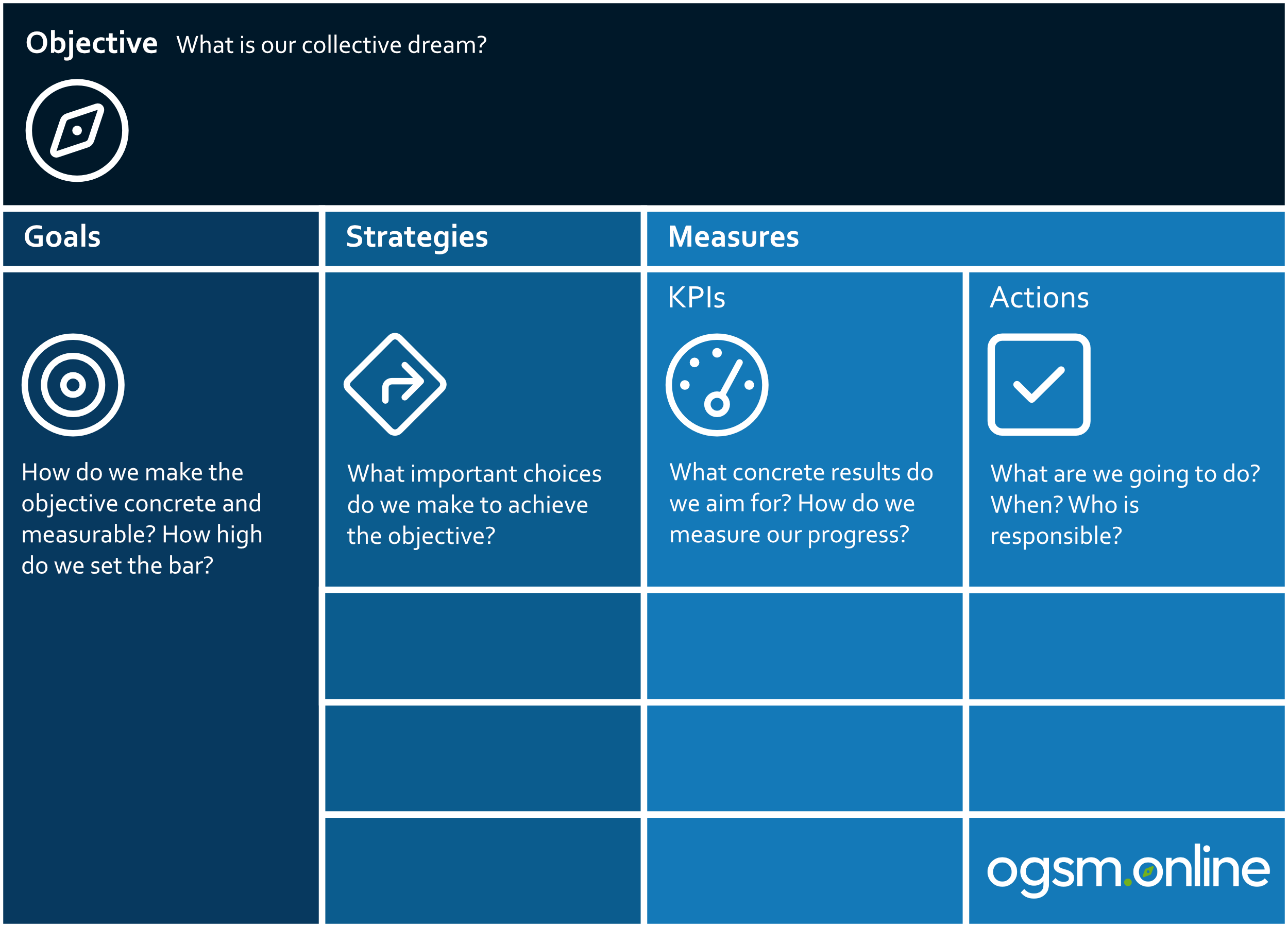
Objective
Your Objective is the ambition: where do you want to be in three to five years? It’s written in words, not numbers, and it should inspire. A good Objective answers two questions at once: what do you want to achieve, and how will you get there? We call this the [WHAT] by [HOW] pattern.
“Become the preferred partner for sustainable packaging in Europe by combining innovative design with the shortest lead times in the market.”
One sentence. Sharp. And everyone in the team understands what it means for their work.
Goals
Goals make your Objective measurable. They answer the question: how do we know we’re succeeding? Typically three to five Goals, each with a concrete target value. Not “improve customer satisfaction” but “customer satisfaction ≥ 8.5”. The best Goals are just achievable, ambitious enough to stretch, realistic enough to believe in.
Strategies
Strategies are your choices: how will you achieve the Objective? This is where OGSM differs from many other methods. Choosing means saying no. Three to five strategies, no more. Each one describes a deliberate route, and implicitly, all the routes you decided not to take.
Measures
Measures make execution concrete, in two forms:
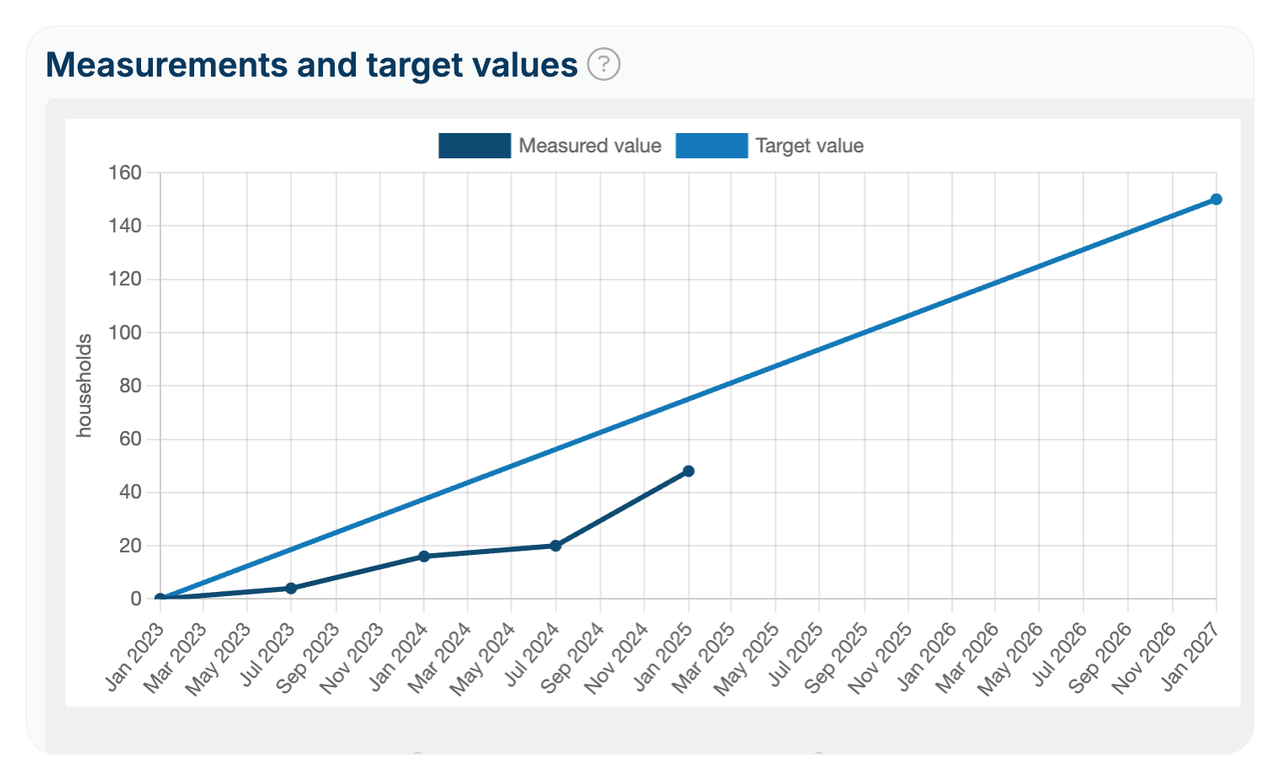
- KPIs (indicators): the dashboard of your plan. Is each strategy on track? Measurable, with target values per period.
- Actions: what you will actually do, each with an owner and a deadline. This is where strategy meets the workweek.
A plan is nothing without a rhythm
Here’s what we’ve learned from hundreds of teams: creating the OGSM is the easy part. The difference between a plan that works and a plan that gathers dust is rhythm. Two recurring sessions keep your plan alive:
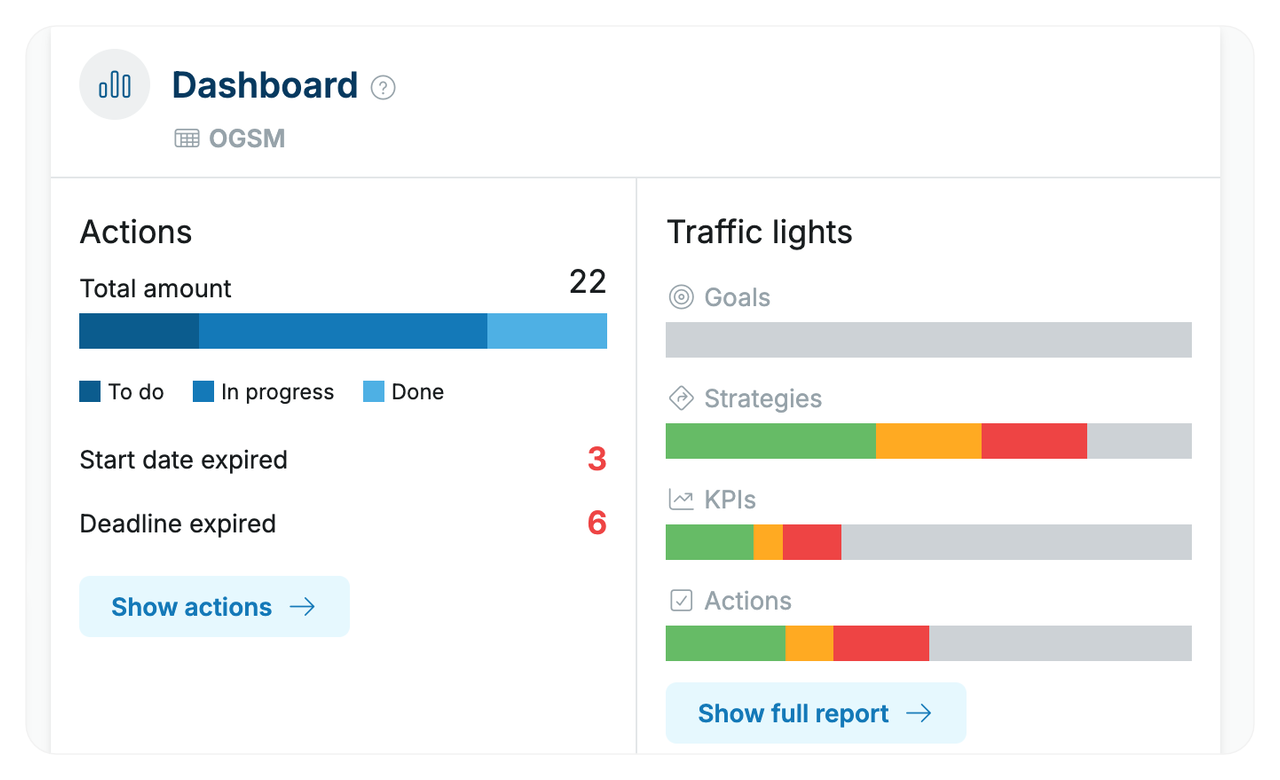
- The action review (monthly): are we doing things right? Owners report on their actions beforehand; the team uses the session to remove obstacles and decide what needs attention.
- The strategy review (quarterly): are we doing the right things? You look at KPIs and results and ask the harder question: are our strategic choices still the right ones? Adjust deliberately where needed.
This is what makes an OGSM a living plan instead of a static photo. And it’s exactly the cycle OGSM.online is built around.
OGSM vs. OKR
People often ask how OGSM compares to OKR (Objectives and Key Results). They’re related: both connect ambition to measurable results. But there’s one crucial difference: OGSM makes your strategy explicit. OKR tells you what to achieve; OGSM also captures how you choose to achieve it, and turns those choices into concrete actions with owners. Read the full comparison in our article OKR vs. OGSM.
Getting started
You don’t need weeks of workshops to create your first OGSM. Get your team together, block a few good sessions, and start with the Objective. Expect discussion. That’s the point. The conversation about what not to do is often more valuable than the plan itself.
Want a head start? OGSM.online guides you through every building block, scores the quality of your plan as you go, and helps you formulate with AI. Try it free for 30 days.