
Open a team dashboard and you see a wall of green. Every strategy on track, every action progressing, every KPI where it should be.
Congratulations, possibly. More likely, your dashboard has stopped telling you anything.
The tell
There is a pattern we see often enough to recognise it from across a room.
Months of green. Then, somewhere after the summer, one item flips straight to red (no amber in between) and it turns out to have been in trouble since March. Nobody was lying. Everybody was doing what the system rewarded.
Green-then-red with no amber is the signature of a dashboard people have learned to manage rather than report on.
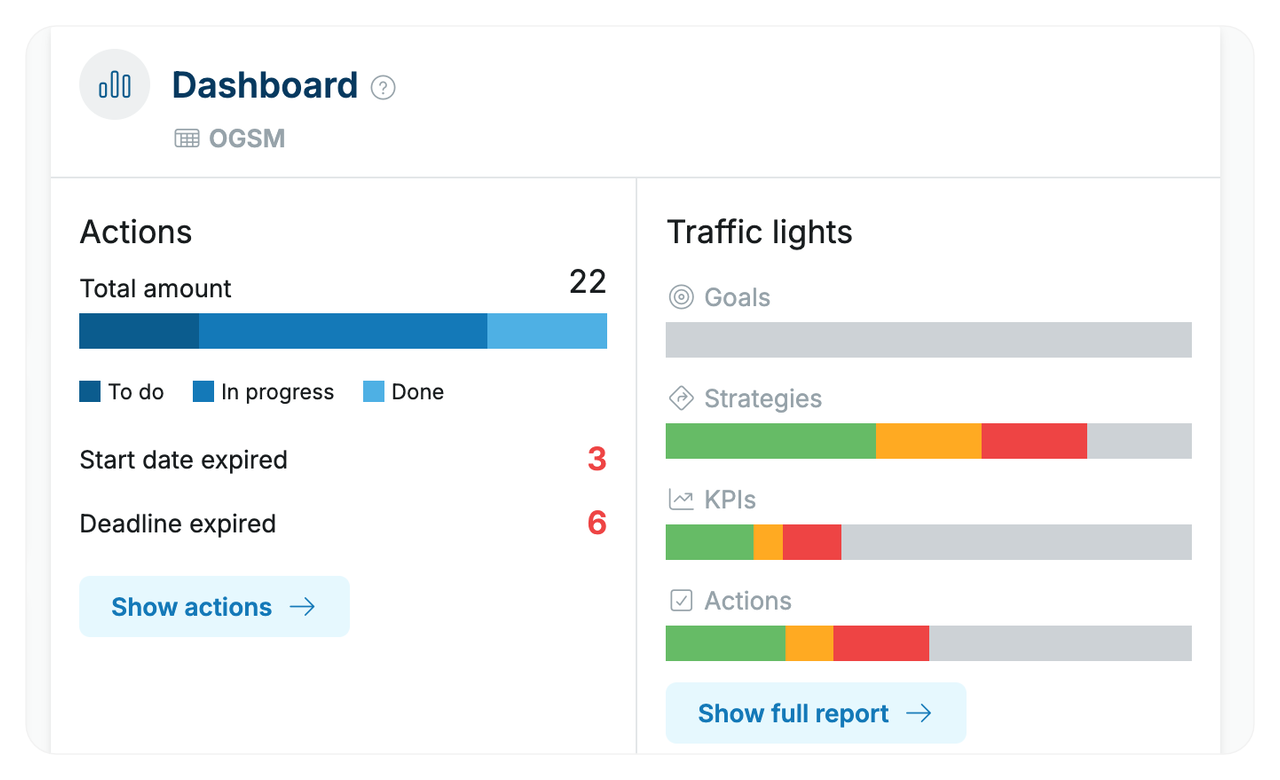
What amber is actually for
The three colours have specific meanings, and the middle one carries most of the value.
Green means on plan. You expect to deliver what was agreed, when it was agreed.
Amber means you are worried (about quality, about the deadline) and with the right intervention it can come back to green.
Red means it is not feasible as it stands, and the team has to choose: move the deadline, accept a smaller result, or accept lower quality.
Amber is the only colour that asks for help while help can still change the outcome. Green needs nothing. Red is damage control. Amber is the whole early-warning system, compressed into one word.
A dashboard with no amber on it has thrown that away.
Why people stop reporting it
Nobody decides to hide things. The behaviour is produced by the environment, and usually by one of four things.
Amber gets treated as failure. Someone reports amber and the room’s first question is why it is not green. Do that twice and the team learns. The next amber arrives as green with a hopeful note.
Amber gets treated as a request for oversight. Worse in its way. You report a concern and receive a weekly check-in, a status template and a meeting series. Now amber costs you time you did not have, which was the problem you were reporting.
Nobody answers the ask. The report says “amber, I need someone to unblock legal.” The session notes it and moves on. Third time, the owner stops writing the ask, and shortly afterwards stops writing amber.
Performance review is attached to the colour. The most reliable way to destroy an honest dashboard. If your assessment depends on how much green you produce, you will produce green, and you will favour actions that are easy to finish over actions that matter. Think hard before you connect OGSM to appraisals.
The uncomfortable arithmetic
A team of eight people executing twenty actions over a year. Some of those actions will run into something: a supplier, a dependency, a person leaving, a wrong assumption. That is not pessimism, it is arithmetic.
If your board never shows amber, either you are the luckiest team in your industry, or the information is being smoothed somewhere between the work and the report.
We have never met the first team.
Making amber safe
Four things, none of them software.
Respond to amber with help, not with questions. The first words after someone reports amber should be “what do you need.” That single habit does more than any process change. It converts amber from a confession into a request, which is what it was always supposed to be.
Make the ask a required field. A progress report should say what the owner needs from the team. Not optional. If there is nothing, they write “nothing”, but the prompt means the ask gets made when there is one.
Have someone report amber early and visibly. Ideally the most senior person in the room, on their own item, in the first month. Nothing you say about psychological safety will land as hard as watching what happens to the first person who does it.
Separate reporting from appraisal, out loud. If you use KPIs in performance reviews, say explicitly which ones are hard targets and which exist purely to steer. Most of the damage comes from people not knowing what counts and assuming everything does.
Software will not make amber safe, but it can make sure the signal is not lost. In OGSM.online every report carries a traffic light and an explanation, so the ask sits right next to the colour. And every measurement on a goal or KPI is kept, so the strategy review sees the trend rather than just this month’s colour.
What a healthy board looks like
A board covered in red is a different problem, usually a plan that was never feasible.
A healthy board is mostly green with a handful of amber that changes month to month. Things come under pressure, get discussed, get help, go back to green. Occasionally something goes red and the team makes a real decision about scope or timing.
That is a plan being executed by people who are telling each other the truth. It looks less impressive in a board pack than a wall of green, and it is worth considerably more.
If your dashboard has been entirely green for two quarters, the most useful thing you can do at the next review is ask the question directly: what is on this board that somebody is worried about and has not said?
Then wait. The silence is usually short.