
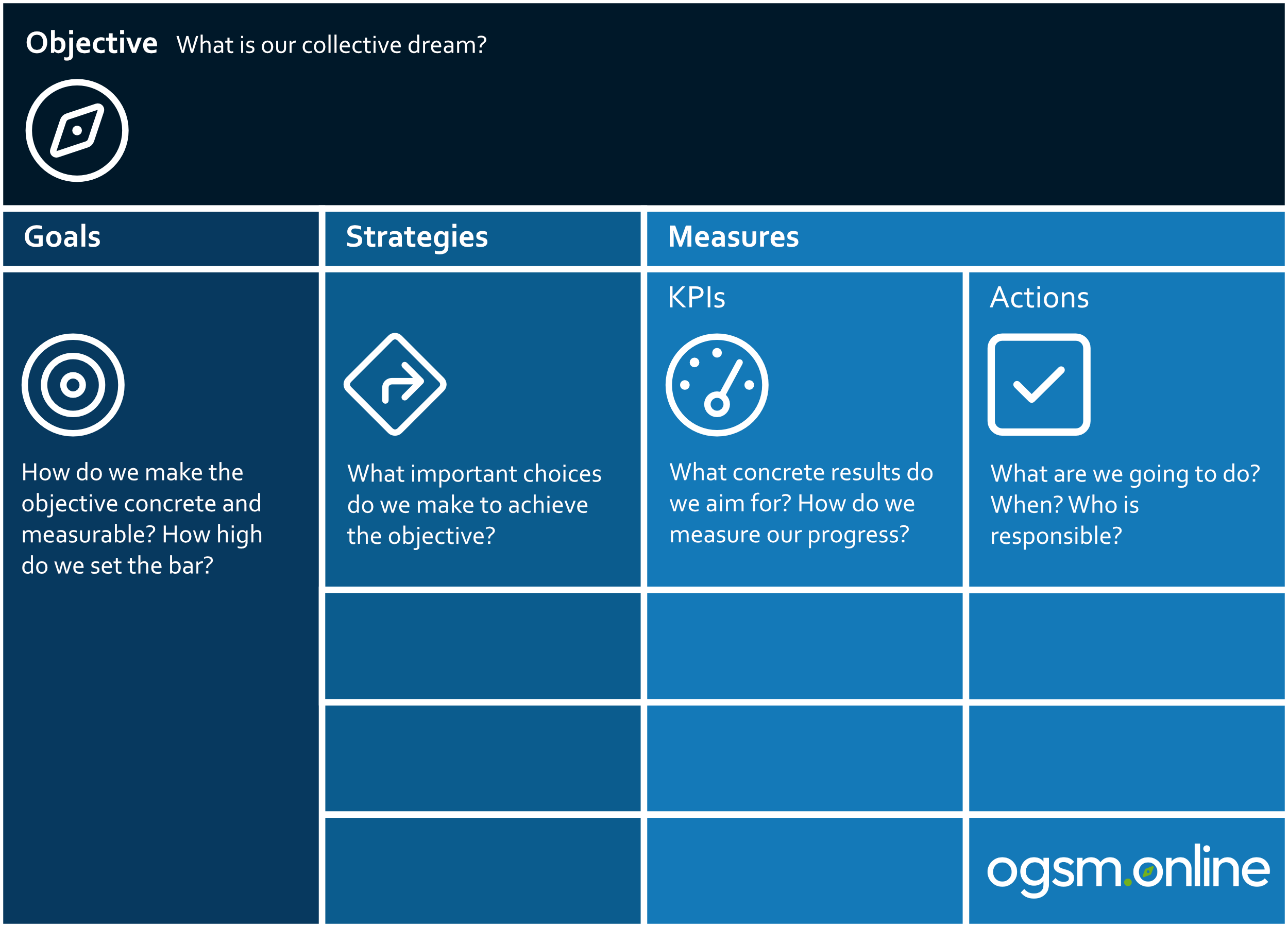
OGSM stands for Objective, Goals, Strategies and Measures. It is a model for capturing an entire strategy on a single page: what you want to achieve, how you will know you got there, which route you choose, and what you will do about it.
The single page is the point. Most plans fail on readership rather than on content. A forty-page strategy document gets presented once, lands in a shared drive, and is never opened again. A plan on one page stays in the room.
Prefer to watch first? Here is OGSM in a couple of minutes.
What OGSM stands for
Each letter is a question the plan has to answer.
- Objective. What is our ambition, our shared dream? One or two sentences, in words, with a horizon.
- Goals. How do we make that ambition concrete and measurable? How high do we set the bar?
- Strategies. Which choices do we make to get there? And, just as importantly, what are we no longer doing?
- Measures. What results do we pursue, how do we track them, and who does what by when? This splits into KPIs (your dashboard) and actions (your work).
Read top to bottom, the four blocks tell one story: this is where we are going, this is what that means in numbers, this is the route we chose, and this is what we are doing about it on Monday morning.
Why one page changes everything
Not every idea fits, so the team has to decide which ones matter most. The conversation about what not to do is often worth more than the plan that comes out of it.
One page also stays visible. You can put it on a wall, open it at the start of every review, and point at the exact line under discussion. Everyone sees the ambition, the numbers, the choices and the work at a glance, so you can check whether they hang together instead of taking it on trust.
There is a catch.
OGSM is simple, and simple is the hard kind. Most teams need three sessions to fill one page.
Making choices and saying them in few words is hard work. If you like vague language and would rather not choose, OGSM is not for you.
The four building blocks
Objective: your ambition in words
The Objective sits at the top and everything else hangs from it. It describes what you ultimately want to achieve (the big ambition) and, in broad strokes, how you intend to get there.
A useful pattern, introduced by Marc van Eck and Ellen Leenhouts in The One Page Business Strategy, is [WHAT] by [HOW]:
Achieving market leadership in five years by democratising electric mobility.
In five years, the housing market in our municipality is balanced, accessible and sustainable by speeding up construction and rewarding sustainable building.
Both halves matter. The what gives people something to aim at. The by gives them direction on how, which is what stops five teams from interpreting the same ambition five different ways.
A good Objective is ambitious enough that you have to work hard for it, and believable enough that the team tries. It carries a horizon, usually three to five years, which is what separates it from a mission, since a mission is timeless and an Objective gets replaced once you reach it. It avoids management jargon, because words like quality and excellence mean whatever the reader wants them to mean. It answers the challenges you face. And it runs to one or two sentences, because nobody remembers an ambition that fills half a page.
Goals: your ambition in numbers
You have an inspiring Objective. Everyone nods. But does everyone mean the same thing by it?
Probably not. What exactly is “the most innovative”? What counts as “the best employer”? Goals close that gap. They are the quantitative translation of the Objective, and they do two jobs.
They make the Objective concrete, so there is no room left for competing interpretations. And they make it measurable, so at the end of your horizon you can say plainly whether you achieved it. Hit all the Goals, and you have realised the Objective.
Some examples:
- Revenue has grown by 25 percent
- Net profit margin above 12 percent
- Employee satisfaction above 8.5 out of 10
- CO₂ emissions cut by half
- Market share in the Benelux above 18 percent
Each Goal names the thing, the target value and the unit. “More revenue from new products” is not a Goal. “Five million euros of revenue from products launched since 2026” is.
Keep the list short. Three to five Goals is normal. Nice-to-haves do not belong on it.
Strategies: the route you choose
The Objective and Goals describe the destination. The Strategies describe the route.
Strategy, in the end, is the art of reaching a goal with the resources you actually have. It is about making the most of limited time, money and people. Every hour and every euro you spend on one thing, you do not get back.
Which means a strategy is only real if it excludes something. If you cannot say what you are not doing any more, you have not chosen. You have just extended the to-do list. In practice, writing down the “no longer doing” list often brings more clarity than the plan itself.
A good strategy passes three tests. Together the set has to add up to the Objective, though some may be preconditions (IT systems, people, communication) rather than direct contributors. Each has to give direction, which the same [WHAT] by [HOW] pattern handles: grow market share in European markets through acquisition rather than organic growth. And each needs one named owner.
Three to five substantive strategies, plus at most two preconditions. Past that you have written a to-do list with headings.
Measures: KPIs and actions
Measures are where the plan meets the week. They split in two.
KPIs are your dashboard. They are linked to a strategy and make it measurable, so you can see during execution whether the route is working. Actions are the concrete work: what gets done, by whom, by when.
A useful distinction inside your KPIs is between effort and result. Say you want to grow product revenue and you start by calling the hundred largest companies in your region. Calls made and brochures sent measure effort. Products sold to new customers and revenue growth measure result. Results are what you are after, but they take time to show up. Tracking effort as well tells you early whether the strategy is being executed at all, long before the outcome is visible.
Ratios usually beat absolute numbers. A budget ceiling tells you whether you stayed inside it. A cost per new customer tells you whether the spend is working, and sometimes the honest conclusion is that the budget should go up.
An action needs a verb you can finish, a strategy it serves, and one owner with a date. “Continuously focus on sustainability” fails the first test: it has no end state, so it reports the same thing at every review forever. And the set as a whole has to fit the capacity you have, which the first draft never does.
A complete example
Here is a whole plan rather than an illustration of one. Sunergie is the company the book works through: a solar panel supplier that sells through installers and, until now, also directly to consumers. It has a promising energy-sharing service whose app keeps failing, a single Chinese supplier for its panels, and margins that have been eroding for years. New owners took over from the founder and want a plan that gets the business to profitability without abandoning what it is for.
Objective
In five years Sunergie is a successful international company by improving the returns of solar panels for consumers and for the climate.
Goals
- Profitability above 15 percent
- Revenue above €35 million
- Active in 5 countries, each with at least €3 million revenue
- Total solar energy generated: 2.6 billion kWh
- Net Promoter Score of 40
- Payback period on solar panels 20 percent shorter than the industry average
- Employee satisfaction above 8.5 out of 10
Dashboard: KPIs
- Installer concentration: no more than 10 installers make up 80 percent of revenue
- Revenue per installer: above €50,000 per quarter
- Installer satisfaction: above 8.5 out of 10
Actions
- Run a needs assessment among current installers (Bram, Q1)
- Improve account manager competencies (Yara, Q2)
- Recruit additional account team capacity (Yara, Q2)
- Launch a lead generation campaign for installers (Bram, Q3)
- Phase out the direct-to-consumer online store (Martin, Q4)
Dashboard: KPIs
- Annual revenue growth: 15 percent
- Share of revenue from outside our home market: 60 percent
- Countries we are active in: 2
Actions
- Research subsidies and export support (Lisa, Q1)
- Research German consumer needs and competitors (Bram, Q2)
- Select and approach German installers (Bram, Q4)
Dashboard: KPIs
- Service satisfaction: above 8.5 out of 10
- Complaints reduced: 80 percent
- IT department size: 15 FTE
Actions
- Set up the IT department and recruit for it (Yara, Q2)
- Establish a customer panel to guide new functionality (Martin, Q2)
- Give customers their own data through the app (Martin, Q4)
- Obtain ISO 27001 certification (Lisa, Q4)
Dashboard: KPIs
- Value added per employee: €110,000
- Employee satisfaction: above 8.5 out of 10
- Development budget used: 100 percent
Actions
- Contract a second panel supplier to reduce dependency (Lisa, Q1)
- Co-develop a lean improvement programme with employees (Yara, Q3)
- Professionalise finance for better management information (Lisa, Q3)
- Give every employee a development plan with a budget (Yara, Q4)
Look at the choices first. The first strategy rests on one action, phasing out an online store that makes money today but competes with the installers the company depends on, and a supplier dependency that could sink the business is handled in a single line. Each strategy sits on its own row with its KPIs and actions, so you can follow one line from the route chosen to who does what by when.
What to notice in the Sunergie plan →
The full example, and one for a non-profit →
Want to build yours in a tool instead of a document that goes stale?
Start your free trialGoals or KPIs? The distinction that trips people up
This is where most teams get stuck, and most explanations of OGSM skip it entirely.
Goals and KPIs look similar. Both are numbers with target values. The difference is what they are for.
Goals describe the desired end state. You use them at the end of the plan to determine whether you achieved the Objective.
KPIs are used during execution to determine whether you are on track and moving fast enough.
Why does that matter? Take a fast-growing technology company whose Objective is to be financially successful in five years, with a profit target as one of its Goals. For the next three years, profit will be a terrible steering signal: heavy investment means the company will post losses, exactly as planned. Steering on the profit Goal would tell you to stop investing, which would guarantee you miss the Objective.
What you need instead is a dashboard of KPIs: subscriber count, average subscription price, churn, customer satisfaction. Those tell you every month whether you are on the way to that profit, long before the profit itself arrives.
Steer on KPIs. Be judged on Goals. Mix them up and you will either panic too early or find out too late.
Where OGSM comes from
OGSM has no single inventor, but it has a clear lineage.
It starts with Peter Drucker in the 1950s and Management by Objectives. Drucker argued that organizations should focus on results: translate the organization’s goal into sub-goals, so every team knows what result it is aiming for, and only then decide which activities are needed. During execution you evaluate results and adjust activities, because the goal comes first.
Japanese manufacturers, Honda among them, refined those ideas through the post-war decades. But it was Procter & Gamble that crystallised the four-block model and made it a working management practice. From there it spread. The Coca-Cola Company, Unilever, Mars, Toyota, Philips, BYD and Heineken have all used it.
How to build one
You do not need weeks of workshops. A team can get to a solid first version in three sessions.
The short version is four steps:
- Preparation. Name the owner, pick the team, and agree what the plan is for. Then list the challenges you face and phrase them as “how do we…” questions.
- Objective. Brainstorm the words that must appear, then write the sentence. Expect argument. That is the point.
- Goals and strategies. Make the ambition measurable, then decide the route, and appoint an owner per strategy.
- Measures. Strategy owners draft their own KPIs and actions, the team gives feedback, and you prioritise on value and feasibility.
In practice, plenty of teams do not start at the top. Some begin with the strategies they already know they want, and work back to the Objective. That is fine. There is more than one route in.
The four steps in full, with the three routes →
A plan is nothing without a rhythm
Almost every article about OGSM stops at the finished page. This is the part that decides whether it survives.
The plan you wrote in January describes a world that has already moved. Writing it is maybe twenty percent of the work; the other eighty percent is doing, learning and adjusting.
That rhythm is two separate conversations.
The action review, monthly. “Are we doing things right?” Owners report on their actions before the meeting, so the hour goes to what is stuck and who needs help.
The strategy review, quarterly. “Are we doing the right things?” You look at the KPI trends, ask whether the route still makes sense, and change it when it no longer does.
Keep the two apart. Mixed sessions let strategy debates swallow the monthly hour, or let the strategy go unquestioned for a year.
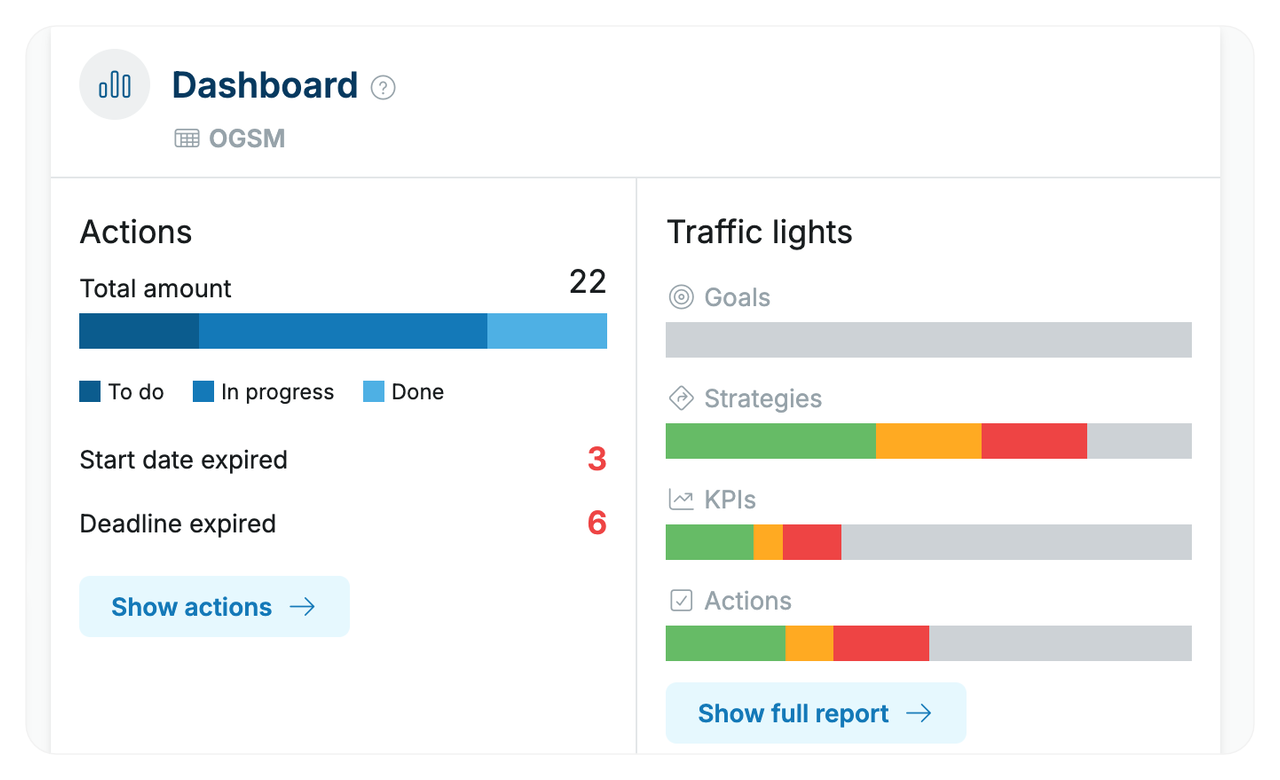
This is what a spreadsheet cannot give you: in OGSM.online every owner’s report feeds one dashboard, and each KPI keeps its history, so you see the trend and not just this month’s number.
See your own plan on this dashboard after the first round of reports.
Start your free trialHow the action review and strategy review work →
Connecting plans across teams
One OGSM is straightforward. The interesting problem starts at five, or fifty.
When teams each have their own plan, those plans need to hang together: vertically, so a team’s plan supports the level above it, and horizontally, so teams that depend on each other are not quietly pulling in opposite directions.
In practice this works through links rather than copies. A team’s Objective can be derived from a strategy one level up. An action in one team’s plan can be the thing another team’s strategy depends on. Done well, you can trace a line from a single action on a team board all the way up to the organization’s ambition.
How OGSM.online keeps connected plans coherent →
OGSM or OKR?
They are more alike than most comparisons admit, and you can run both.
Both connect ambition to measurable results. Both exist to kill the forty-page plan nobody reads. There are differences, but they are narrower than the internet suggests:
- Cadence. The same, near enough. Both run on months and quarters. OGSM’s monthly action review and quarterly strategy review are the model’s own rhythm rather than a convention on top of it.
- Horizon. OGSM sets a three-to-five year ambition and measures each quarter against it. OKR resets objectives quarter by quarter. So the difference is not speed; it is whether the quarters have a yardstick.
- Strategy. This is the one that matters. OGSM puts the strategic choices on the page. OKR tells you what to achieve; OGSM also captures how you chose to achieve it.
- Actions. In OGSM the actions live on the same page as the ambition. In OKR they usually live somewhere else, which is exactly where momentum tends to leak away.
If your teams are autonomous and mainly need direction on outcomes, OKR serves well. If you want one plan that connects direction, choices and execution across several teams, OGSM is the more complete instrument, and it gives you the quarterly focus too. Plenty of organizations run both: OGSM for the plan at organization and department level, OKR for the quarter inside teams.
The full comparison, including when to use both →
Who uses OGSM
Almost anyone who needs a plan and has limited resources. In practice we see it work for:
- Solo entrepreneurs and fast-growing companies
- Manufacturers and technical companies
- Financial institutions and pension administrators
- Healthcare organizations
- Municipalities and government bodies
- Industry associations and volunteer organizations
- Individual departments and teams inside larger organizations
- Individuals, as a personal development plan
The complexity varies enormously. The value does not: you know what needs to happen and you can steer.
One objection comes up often enough to answer here. “We’re a people-oriented organization: we’re not all going to keep lists in a spreadsheet.” Every team we have worked with got happier once its effort started producing visible results. OGSM is about the people in the team and the conversations they have; the page is just where those conversations get recorded.
Where OGSM plans go wrong
Most failures are not failures of the model. They are failures of choosing and of rhythm.
- The plan with no direction. Forty pages of grand narrative and distant horizons, so broad that any activity can be justified by it.
- The plan because the boss said so. Written every year because there is no budget without one, and referenced never again.
- The shadow plan. There is a plan, and then there is what the team works on day to day. If those differ, the plan is decoration.
- Too many strategies. Seven or eight “priorities” means no priorities.
- Empty words. “We aim for excellence” is not a strategy. “Customer satisfaction above 8.5” is something you can be wrong about.
- No rhythm. The plan gets written, celebrated, and never opened again.
Seven ways an OGSM goes wrong, and how to fix each →
Check the quality of your plan
Before you call your OGSM finished, test each block. Does the Objective say both what and how, does every Goal and KPI carry a target value and a unit, does every strategy have one owner and a list of what you stop doing, and can every action be finished within one cycle? Then look at the page as a whole: one plan, one owner, no shadow plan alongside.
The full checklist, adapted from the book →
Getting started
Three things, in order.
Get the right people in the room. The team that will execute the plan is the team that should write it. People defend what they argued for, and file what they were sent.
Start with the Objective, and expect friction. The argument about what you are trying to achieve is the session, not an obstacle to it.
Then commit to the rhythm before you commit to the plan. Put the monthly action review and the quarterly strategy review in the calendar for the next year, today. Without that rhythm, the plan stays a document.
Eighty percent is good enough to start. The last twenty percent gets written by executing the plan, not by holding another session about it.
The rest of the guide
Writing the plan
- How to write an OGSM in four steps, preparation, then the four blocks
- The template: what belongs in each box
Seeing it done
- Two complete examples: a commercial one and a non-profit one, filled in
Making it work
- The rhythm: action review and strategy review
- Annual planning: using OGSM for the yearly cycle
- Why plans fail: seven pitfalls and their fixes
Comparisons and context
- OGSM vs OKR · vs Balanced Scorecard · vs Hoshin Kanri · vs SMART goals
- Choosing OGSM software: what to evaluate, including where we are the wrong answer
Deeper than any page goes
Everything here is the working method, given away because it is more useful to you than to us. The reasoning behind each choice, the worked examples in full and the facilitation detail are in the book.