
A plan that lives apart from every other system slowly stops matching reality. So OGSM.online is built to hand its data over and to take numbers in.
The API
Every plan includes an API for using OGSM data in other applications.
There is an endpoint per element of the plan: teams, OGSMs, objectives, goals, strategies, KPIs, actions and their progress reports. Reading covers the whole plan, and measurement values on goals and KPIs can be written back. Authentication is a bearer token you generate yourself under Settings.
Two patterns come up most:
Business intelligence. Pull plan and progress data into Microsoft Power BI (or any BI tool) so strategic progress sits alongside your operational reporting instead of in a separate tab nobody opens.
Work management. Connect to Jira or a comparable system, so the delivery work tracked by teams lines up with the actions on the plan rather than being maintained twice.
A warning about the second one. It is tempting to sync every ticket into the strategic plan, and it is a mistake. That plan holds strategic actions; the ticket-level backlog belongs a level down, either in Jira or in the project’s own OGSM. Keep the link at the level where a Jira epic corresponds to an action on the strategic plan, and the two systems stay useful. Push it further and the OGSM turns into a project tool with an ambition stapled to the front.
Importing measurements
The most common reason a dashboard goes stale is that someone has to retype numbers that already exist somewhere else.
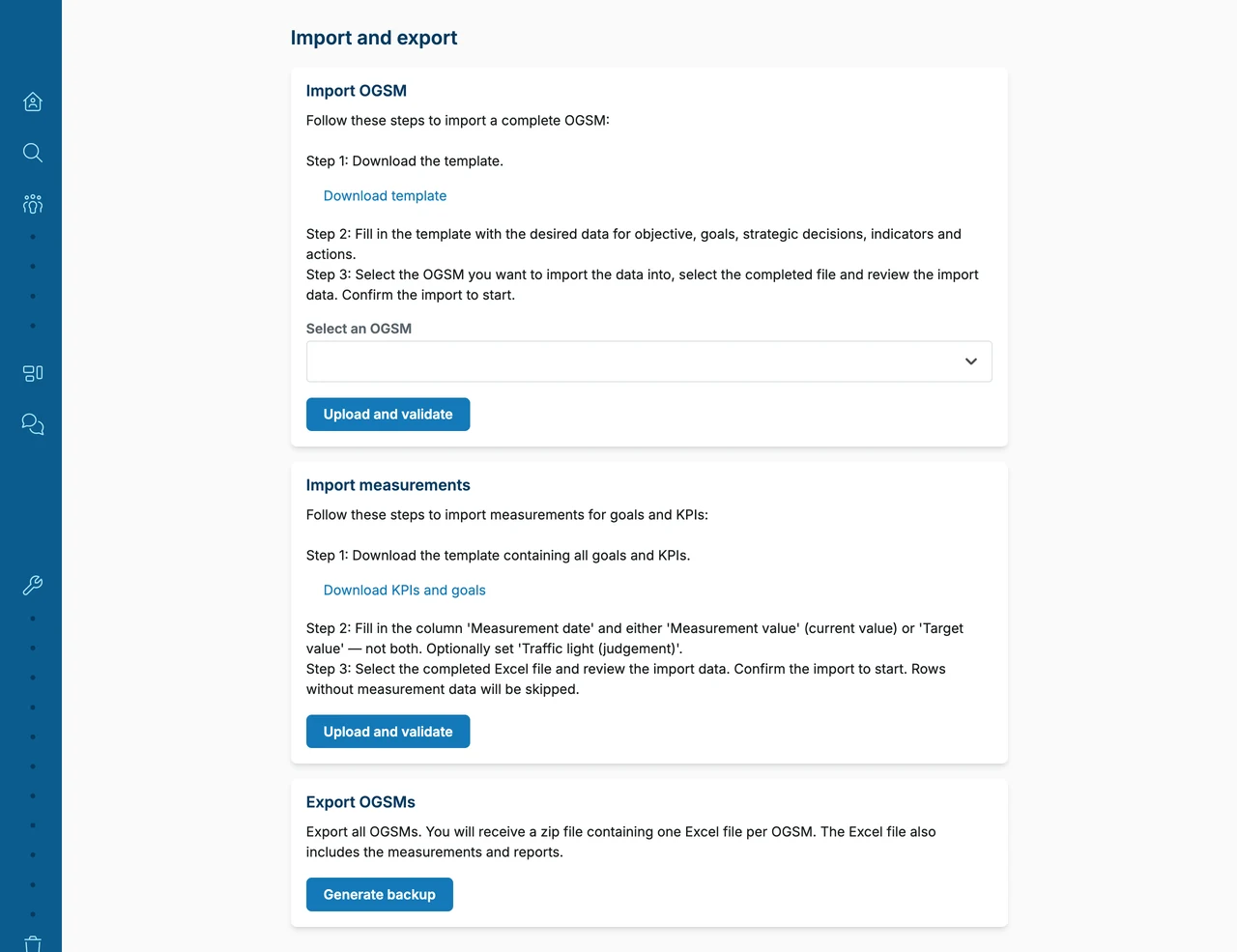
So measurement values for goals and KPIs can be imported from external sources. Revenue from the finance system, satisfaction from the survey tool, emissions from the reporting platform: updated at the source, reflected in the plan.
This is also what widens the range of usable KPIs. A number already collected somewhere costs an afternoon to connect. The theoretically ideal indicator that needs its own data pipeline costs a quarter, during which the strategy has no dashboard at all.
Single sign-on
Single sign-on with Microsoft Entra ID, formerly Azure AD, is included on every plan.
Beyond convenience, the reason to want it is offboarding. When access is granted through your identity provider, it ends when the account does. Manual user lists always drift, and the drift is invisible until it matters.
Two-factor authentication is included on every plan regardless.
More on access, roles and user groups →
Getting data out
Not everything is an integration. Sometimes you just need the plan somewhere else.
- Excel export of the full OGSM or any report, for analysis
- PDF export, laid out to stay a one-pager, for board packs and printing
- Excel import to bring an existing OGSM in, so you are not retyping a plan you already have
That last one matters if you are moving off a spreadsheet, as most teams are. What breaks in one, and what to evaluate instead →
Mobile
iOS and Android apps, on every plan.
They are aimed at the reporting end of the cycle rather than the building end: check status, update an action, file a progress report from somewhere other than your desk. Writing a plan is still a job for a room with a big screen in it.
The API is in every plan, the trial included. Create a token on day one and connect your own data. Want to check a specific integration first? Book a demo.
Start your free trial Book a demo