
The plan is written. The Objective is sharp, the Goals are measurable, the strategies are real choices and every action has an owner. Well done.
Now comes the part that decides whether any of it mattered.
A plan is a film, not a photograph
A plan is made with the knowledge you had on the day you made it. Then the world carries on. Circumstances shift, actions produce different results than expected, and insights change.
So a plan should never be a static picture. It is a film, with new plot twists every quarter. That means adjusting it mid-course is not a failure of planning. It is allowed, and it is encouraged. As long as you do it deliberately, with proper attention to the consequences.
That word, deliberately, is the whole thing. What a rhythm buys you is awareness: a team that always knows why it is doing what it is doing, and can therefore make considered choices instead of being swept along.
An action going off plan is not a problem, as long as you know why and can learn from it. Changing the plan is not a problem, as long as you do it to get a better or faster result. What is a problem is not noticing either one.
Twenty percent plan, eighty percent execution
In practice we see a lot of organizations that love making plans. Analyses, drafts, careful work on the coherence between plans. And then far less attention, sometimes none, to how the plan will actually be executed and kept alive.
Turn that around.
Spend twenty percent of your effort on writing the plan and eighty percent on executing it.
If you only take one thing from this page, take that ratio.
Dialogue, discipline, ownership
Across the teams we have supported through this, three things separate the ones where it works from the ones where it fades.
Dialogue. Regular, real conversation. Two questions carry it: are we doing things right? and are we doing the right things? Everything below is machinery for having those two conversations well.
Discipline. Good conversations on a fixed rhythm are hard. The daily hectic swallows everything, and months pass without anyone opening the plan. A fixed structure (meetings in the calendar, a standard way of reporting) is what protects the content. It looks like bureaucracy and functions as the opposite: predictable form means you spend your energy on substance rather than on organising the meeting.
Ownership. Every strategy and every action has one named owner. They report progress, they ask the team for help, they are the point of contact. Clear ownership removes the ambiguity that quietly kills execution.
Many teams also appoint a process owner: someone who watches overall progress and facilitates the review sessions. It is a small role and it makes a large difference, because otherwise “keeping the rhythm” belongs to everyone, which means nobody.
The action review
Monthly. The question: are we doing things right?
The focus is actions. Not strategy, not the ambition: the work in flight and what is getting in its way.
The goal is specific: find the actions that are not going to plan and work out how to improve their execution. That is it. It is a short session, and it should feel practical.
Before the session, every action owner updates their action. In the session you skip past everything that is fine and spend the time on what is stuck: why it is stuck, what would unstick it, and who does what next.
The strategy review
Quarterly. The question: are we doing the right things?
Now the focus moves up. You look at the KPI dashboard per strategy and ask what the numbers are telling you.
Every plan rests on assumptions: about your environment, and about what the actions would produce. Only time tells you whether those assumptions were right. This session is where you find out.
Three questions per strategy:
- What do we make of these results?
- What should we keep doing, and what should we stop?
- What new actions do we need?
Sometimes the honest answer is that a strategy that looked right in January no longer is. Better to know that in April than next January.
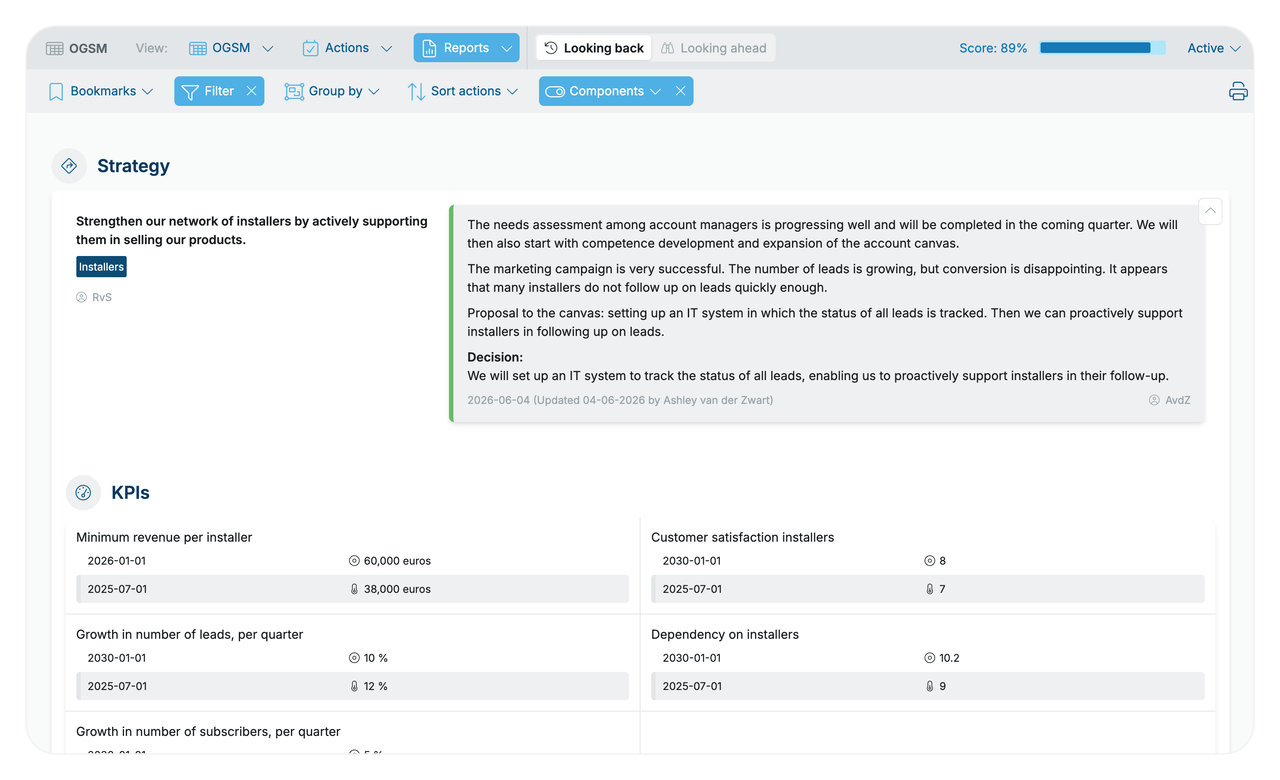
Before the strategy review, divide the plan’s total span into periods: quarters for an organization, phases for a project. Each period you track progress; at the end of it you evaluate results. That segmentation is what makes a five-year plan reviewable at all.
Why the separation matters
It is tempting to fold the two into one meeting. Resist it.
Teams that mix them get the worst of both. Either the monthly meeting balloons into a strategy debate (and execution stalls while everyone relitigates the plan) or strategy never gets questioned at all, and the team spends a year diligently executing something that stopped making sense in March.
Separate the rhythms and both conversations improve. Fast and practical every month. Thorough and honest every quarter.
Reporting before the meeting
This is the single highest-leverage habit in the whole method.
Owners report on progress before the session, not during it. A progress report has three parts:
Progress. What percentage of the work is done, from 0 to 100.
Assessment. Your own judgement of how it is going: green, amber or red.
Explanation. Why that colour, what you have done, what you will do next, and what you need from the team.
That last part is what people skip and what makes the session worth attending. A report saying “amber, waiting on legal, I need someone to escalate” turns a status update into a decision the meeting can actually take.
When reporting happens beforehand, the session itself changes character. Nobody reads out numbers. You arrive already knowing where the trouble is, and spend the hour on it.
The traffic light
Three colours, and the definitions matter more than they look.
Green. On plan. You expect to deliver the agreed result in the agreed time.
Amber. Worrying. You have doubts about the quality of the result or about the deadline, but with the right intervention it can come back to green. Amber is a request, not a confession.
Red. Not feasible as it stands. Something has to give, and the team has to choose which: move the deadline, accept a smaller result, or accept lower quality.
Two things go wrong with traffic lights in practice.
Nobody reports amber. If amber is treated as failure, everything stays green until the month it turns red. Amber has to be safe to say, and the fastest way to make it safe is for the session to respond with help rather than with questions. Why an all-green board is a warning sign, and four ways to fix it →
Red is treated as a status rather than a decision. Red means a choice is required, from the team, in that session. A red that survives three reviews has stopped being a warning and become an item nobody wants to decide about.
Golden rules
Put the sessions in the calendar for a year, before you finish the plan. Rhythm decided later is rhythm that never happens.
Report before, decide during. If the meeting is spent hearing what people did, it is not a review.
Keep the two questions apart. Monthly is about execution. Quarterly is about direction.
Make amber safe. A board that has been entirely green for two quarters is telling you about the reporting, not about the work.
Change the plan deliberately, and write down why. Adjusting is encouraged. Drifting is not. The difference is whether anyone decided.
Keep it short. The length of a recurring meeting decides whether it survives a busy quarter. Aim for the shortest session that can still take a decision.
Ready to see how this works when several teams are doing it at once? How connected plans stay coherent →