
Quarterly strategy review. One of your five strategies has been amber since the start. The KPIs have barely moved. The owner is doing everything right and it is still not working.
Somebody has to say the thing nobody wants to say.
Teams are good at adding strategies. They are much worse at removing them, and the cost of that asymmetry compounds every quarter.
Why nobody says it
Four reasons, and only one of them is about the strategy.
Sunk cost. Eighteen months of work, a team built around it, a budget defended. Stopping now means all of that was wrong, which is not what it means, but it is what it feels like.
It is somebody’s strategy. Named owner, personal credibility, possibly the reason they were hired. Ending a strategy in a room feels like ending an argument about a person.
The plan says it is a priority. There is a certain authority to the page. It was decided, it was written down, and questioning it feels like questioning the process rather than the content.
Nobody wants to be the one. Everyone in the room suspects it. Being the person who says it out loud carries a social cost that being quietly sceptical does not.
So the strategy stays, at forty percent effort, producing nothing, absorbing attention that another strategy needed. That is the real damage: less the failed bet than the year of half-funding that followed it.
More time or wrong route?
The question is not “is this working.” It is “is this not working yet, or not working at all.” Four tests help.
Is the causal chain intact? Your strategy assumed that doing X would produce Y. Are the actions happening? If they are and Y has not moved, that is evidence about the strategy. If the actions have not happened, you have learned nothing about the route. You have learned something about capacity.
This is the one teams most often get wrong. A strategy that was never executed has not failed. It has not been tried.
What did we expect by now, and did we write it down? A KPI that is flat after two quarters means something quite different depending on whether you expected movement in quarter one or quarter four. If you did not say at the time, you are now arguing from memory, and memory is generous to plans people like.
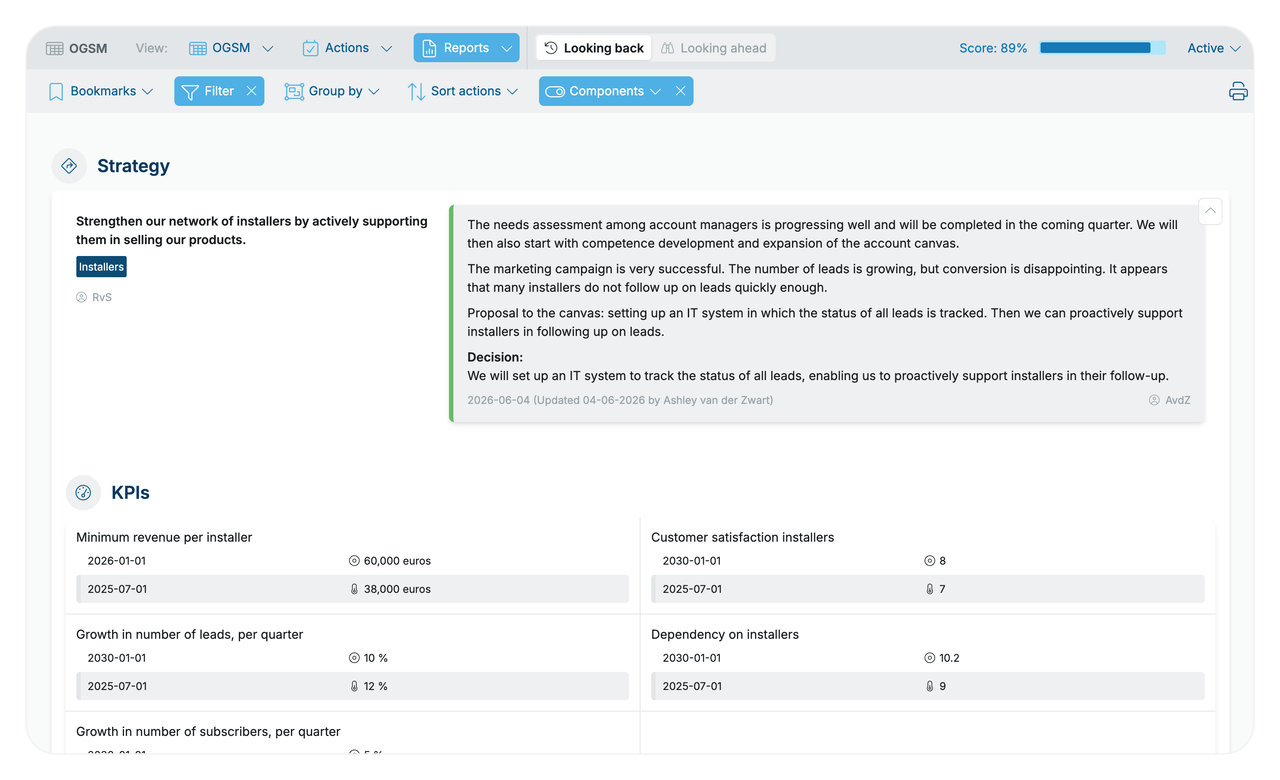
In OGSM.online each KPI keeps every measurement next to its target value, and the progress reports on the strategy sit alongside, so the answer is on the screen rather than in someone’s recollection.
Has anything about the world changed? Sometimes the route was right and the ground moved: a competitor, a regulation, a supplier. That is a different conversation from “we were wrong,” and it usually leads to a different answer.
Would we choose this again, knowing what we now know? The most useful question, and the hardest to ask honestly. “Should we stop” invites defensiveness. Ask instead: “if we were writing the plan today, from here, would this be one of the five?”
If the answer is no, you have your answer. What remains is how.
Doing it well
If the answer is that the route was wrong, four things make it survivable.
Say what you learned, and put it in the record. A strategy that ends having taught the organization that a market is smaller than it looked has produced something. Write that down. It is the difference between a decision and a defeat, and it is what stops the same bet being made again in three years by someone new.
Separate the strategy from the owner, explicitly and in public. The owner executed. The route was the team’s decision. It was in the team’s plan, agreed in a session everyone attended. Say so out loud, in the room. What happens to the person who owned the failed strategy is watched very carefully by everyone who currently owns one.
Decide where the capacity goes. A strategy stopped without reallocating its resource does not free anything up; the work quietly continues under other names. Say which strategy gets the people, or say the capacity comes back to the organization.
Update the page. Remove it. Note in the change log what was removed and why. A plan that only ever accumulates is a plan nobody believes.
The half-measure that is worse
There is a tempting middle option: leave the strategy in the plan but stop resourcing it.
Do not. Now you have a plan that says one thing and an organization doing another, which is precisely the shadow plan the whole method exists to prevent. Everyone can see the gap, nobody can name it, and the plan quietly loses its authority, first for that strategy and then for all of them.
Either it is a priority or it is not. Both are respectable. The gap between them is not.
Once a year, ask it about all of them
Killing a strategy mid-plan should be rare, and it is easier if the question is routine rather than an event.
Once a year, when you step back to review the foundations, run the same test across every strategy: knowing what we know now, would we choose this again?
Asked about all five at once, it stops being an accusation about one. It becomes part of the normal upkeep of a plan.