
Look closely at the action list of most OGSMs and you will find things that are not really actions.
“Replace the core system.” “Set up the German subsidiary.” “Migrate to the new platform.” These are programmes and projects. They run for quarters rather than weeks, they cost serious money, they need people from three departments, and they will quietly absorb whatever capacity you give them.
An organization that treats them as ordinary actions ends up with twenty of them running at forty percent effort. Everything is in progress. Nothing finishes. And because nothing has formally been stopped, nobody has to admit that the list is longer than the organization.
Portfolio management is the discipline of making those choices on purpose: what to start, what to improve, and what to stop.
Three phases, two decision points
The whole thing is a funnel with two gates in it. Initiatives come in at the wide end, and at each gate a session decides which of them go on.
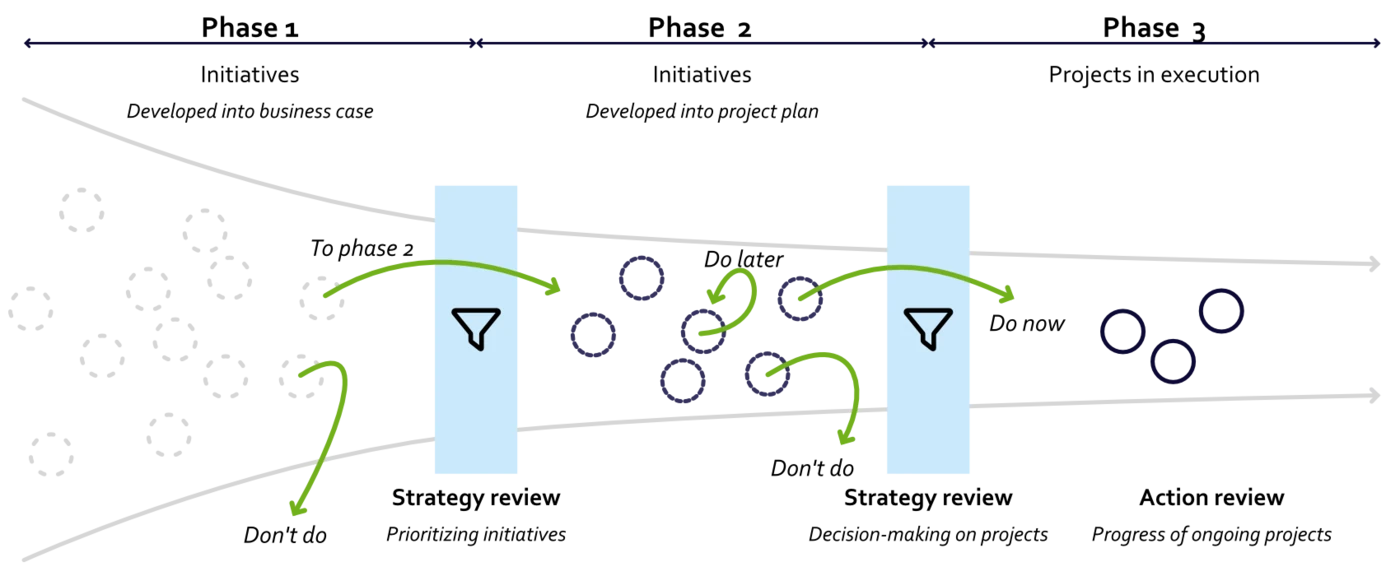
Note where the gates are. They are not extra meetings. They are the strategy review you already hold every quarter, doing one more piece of work. A portfolio process that needs its own governance layer gets skipped by March.
Phase 1: inventory the initiatives
The first phase has one job: finding out what is on the table. Deciding comes later.
Collect every initiative anyone is proposing, including the ones already quietly under way, and work each one up far enough to be comparable with the others. That means a short project initiation document or business case covering:
- The result. What is different once this is finished
- Urgency. What happens if it starts a year later, which is often “nothing”
- Stakeholders. Who has to be involved, and who can stop it
- Costs and capacity. Money, and more importantly whose time
- Risks. Only the ones that would change the decision
Then score each initiative on value and effort using the Fibonacci scale: 1, 2, 3, 5, 8, 13, 21. The gaps widen as the numbers grow, which is honest about how well anyone can estimate. A team can score twenty initiatives in an hour this way, and the result is accurate enough to sort them even though no individual number is defensible.
Plot the two against each other and the shape of the portfolio becomes visible immediately. High value, low effort is where you start. High effort, low value is the quadrant everyone recognises and nobody wants to name out loud.
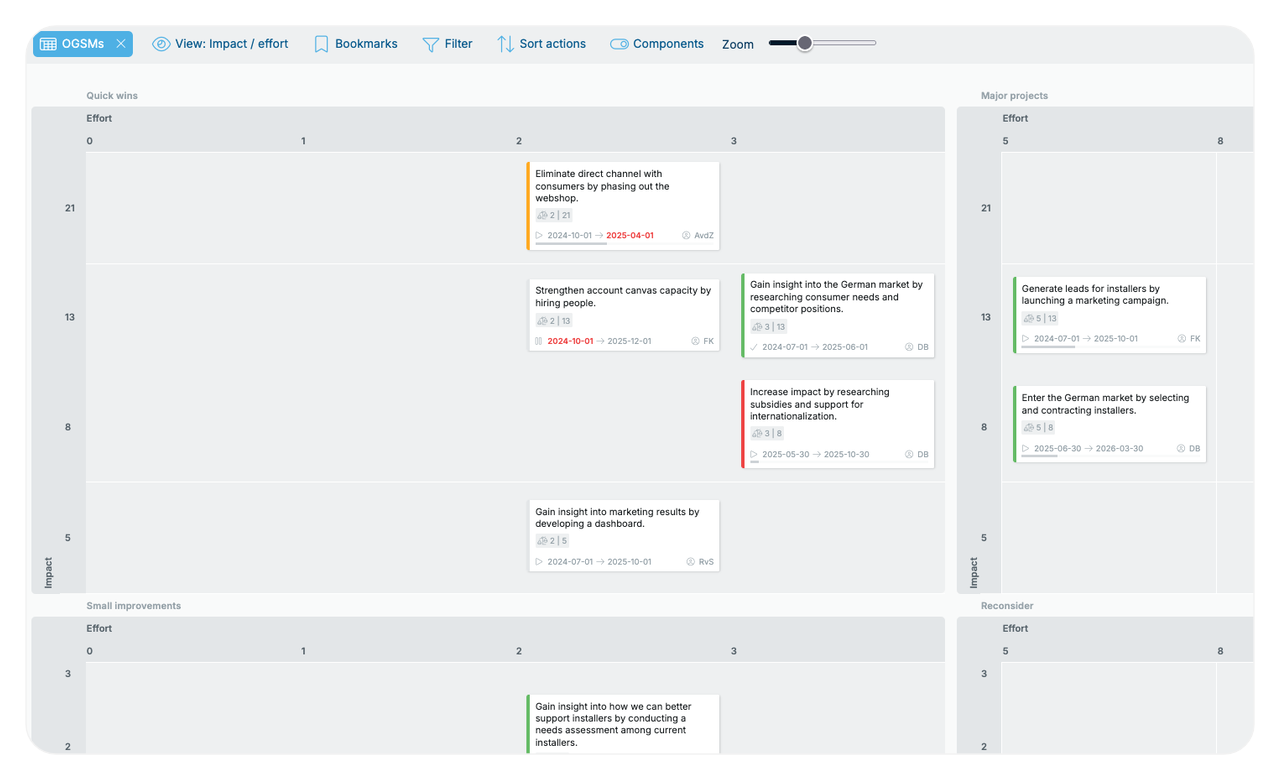
Phase 1 ends with a decision, and it has to be made: which initiatives go through to phase 2, and which ones you are not going to do. Not “later”. Not “parked”. Not done. An initiative that never gets a no keeps consuming attention, and attention is the resource you are shortest of.
Phase 2: develop the plans
The initiatives that survived get worked up properly. This is where a promising idea becomes something you could hold someone to.
A project of any size deserves its own OGSM. Same four blocks: an objective saying what this project is for, goals that make it measurable, the strategic choices about how to run it, and measures split into the KPIs you steer by and the actions the team takes. It is the same model as the plan above it, which is what lets a project stay connected to the strategy it came from instead of drifting into its own universe.
Record the budget in both currencies: money and time. Time is the one that gets left out and the one that actually binds. Two projects can both be affordable and still be impossible together, because they need the same four people in the same quarter.
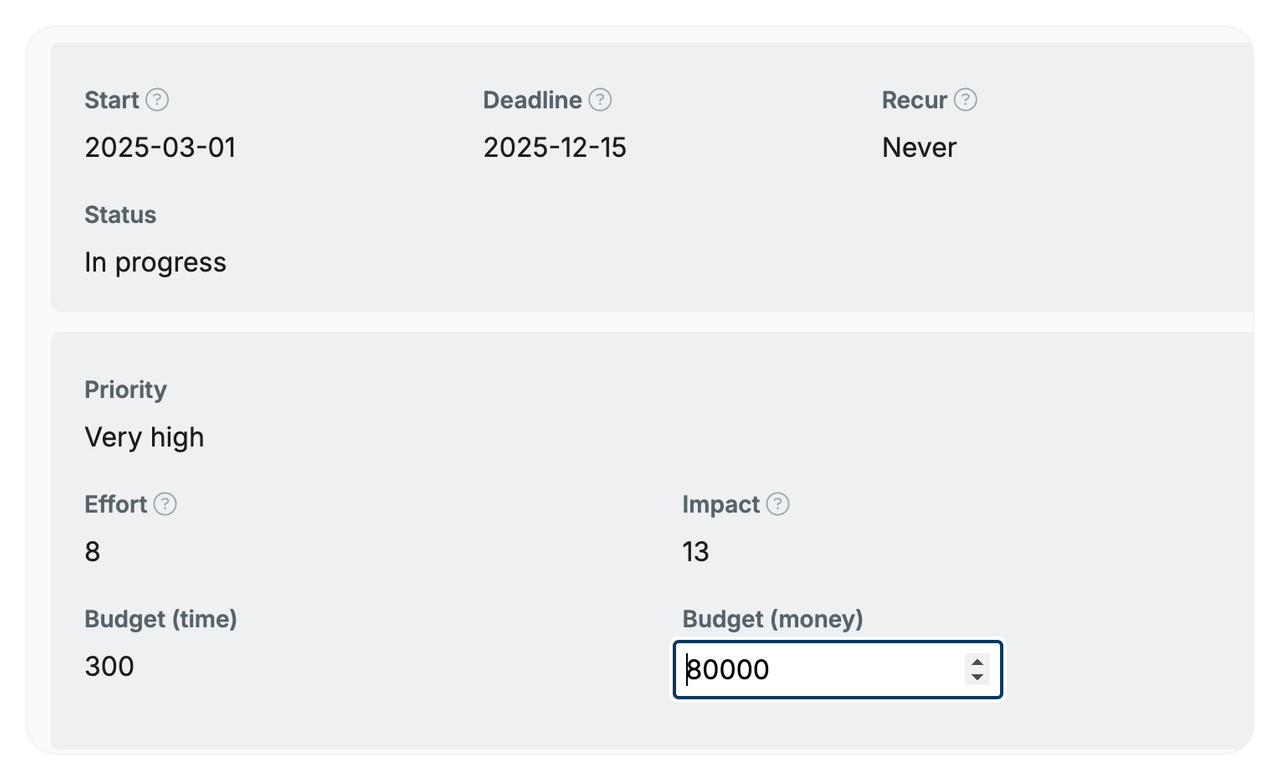
The second gate is where the start decisions are made, and it needs a weighting framework rather than a debate. Ours has four criteria and yours can differ, but write them down before you look at the projects:
- Strategic contribution. Which strategy does this serve, and how directly
- Value against effort. The ratio, not the value on its own
- Available capacity. Whether the people exist, in the quarter concerned
- Urgency. Whether the window closes
Three outcomes come out of this session: do now, do later, and do not do. Keeping “do later” separate from “do not do” is what makes the framework survive contact with the people whose initiative did not make it. A clear no is easier to accept than a maybe that never resolves.
Phase 3: execute and steer
Approved projects run in the normal rhythm, because the rhythm is already there.
Monthly, the action review. Owners report before the session: progress, a green, amber or red assessment, and a sentence on what they need. The session spends its hour on the reds and the ambers, which is the only part that needs a room full of people.
Quarterly, the strategy review. The harder question. Is this project still worth the capacity it is using? The evidence is the KPI trend behind the strategy it serves, not the percentage complete on the project itself. A project can be ninety percent delivered and no longer worth finishing, and a quarterly cadence is how you find that out in the third quarter rather than the seventh.
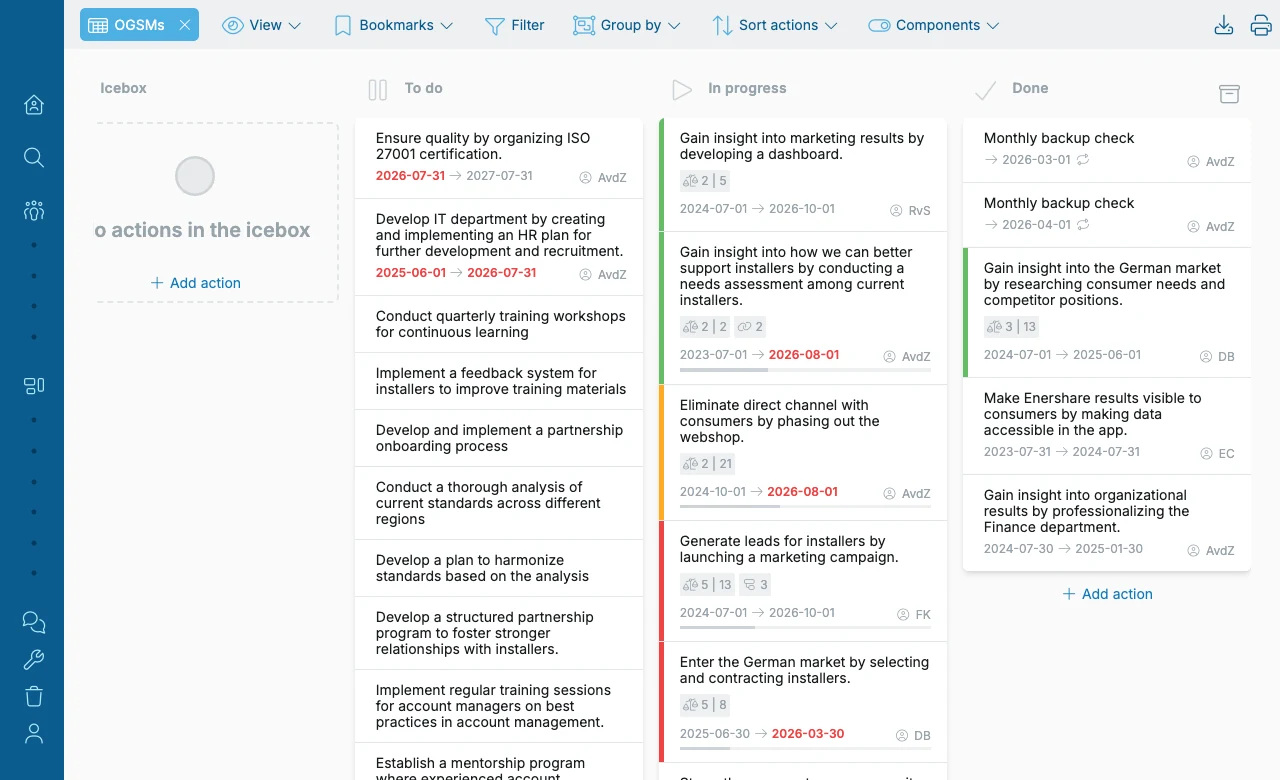
Which means the portfolio is never finished. Initiatives keep arriving, projects finish, some get stopped, and capacity frees up. The two gates come round every quarter, all year.
Doing this in OGSM.online
Everything above works on paper. Here is what the platform adds once the portfolio is bigger than one page.
Collecting. An action can be marked as a programme or a project. It then carries a business case, in a layout an administrator configures to match how your organization writes them, with budget in time and money and its own OGSM underneath.
Overview. Every programme and project in the plan, in one place: as a list, on a timeline, or on the value and effort matrix. Across several plans at once on the Pro plan, which is what portfolio management usually needs.
Steering. Owners file short progress reports with a traffic light. The reports carry budget consumption alongside progress, so the strategy review has both numbers in front of it when it decides whether to continue, adjust or stop.
None of it decides anything for you. What it removes is the week of assembling the picture before you can have the conversation, which is usually why the conversation gets postponed.
Thirty days, no credit card, and the trial stops on its own.
Start your free trial